


Artificial intelligence has accelerated faster than any technology shift in recent memory. What began as optional experimentation has evolved into everyday behaviour: staff using ChatGPT, Gemini, Copilot, Claude and countless emerging tools to speed up tasks, refine messaging, summarise reports and solve problems instantly. AI is no longer a future concept — it’s already embedded in daily workflows.
Across the UK, business owners are discovering that AI is quietly reshaping how their organisations operate. It’s in the tools employees use to write proposals, analyse data, and even respond to customers. It’s in the systems that automate marketing, streamline finance, and support decision‑making. The technology has become so accessible that it’s now part of the digital fabric of every modern workplace — often without formal approval or oversight.
This rapid adoption has created a paradox. On one hand, AI delivers extraordinary productivity gains; on the other, it introduces new categories of risk that traditional IT frameworks were never designed to handle. Sensitive data can move beyond company boundaries in seconds. Regulatory compliance can be breached with a single prompt. And because AI tools are evolving faster than governance policies, many organisations are unknowingly exposing themselves to unseen vulnerabilities.
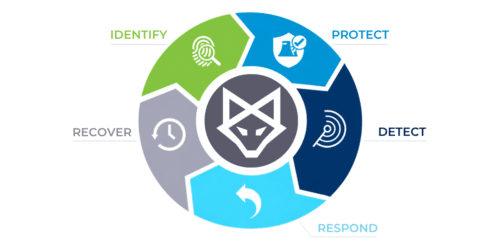 For ERGOS, these challenges have been a catalyst for transformation. Historically recognised as a Managed Service Provider (MSP), our focus was on keeping systems available, supported and efficient – ensuring uptime, backups and smooth operations. But as cyber threats intensified and AI blurred the lines between productivity and risk, it became clear that the role of an MSP had to evolve.
IDENTIFY: Understanding your AI risk surface

The first NIST pillar is about understanding what you have, where your risks are and how AI interacts with your environment.
AI doesn’t create new permissions problems. It exposes existing ones.
As ERGOS highlights in its AI thought leadership, when organisations deploy Microsoft Copilot, the AI can access anything users already have permission to see. If SharePoint permissions are misconfigured, confidential information becomes discoverable through AI-generated responses.
- • Who has access to what data?
- • Are HR, finance and legal repositories secured correctly?
- • Are SharePoint structures designed with least‑privilege in mind?
- • Do data classification and retention policies exist?
Without strong governance foundations, AI simply shines a brighter light on existing risks.
PROTECT: Identity-first security and controlled AI access
The second NIST pillar focuses on safeguarding data and systems. For ERGOS, this begins with identity-first security.
The modern perimeter is no longer the office firewall. It’s identity.
Using Microsoft Entra ID and Conditional Access, ERGOS ensures that access to corporate data is based on:
- • Who the user is
- • What device they’re using
- • Where they’re connecting from
- • Whether the device meets compliance requirements
Compliant devices receive full access. Unmanaged or non‑compliant devices are restricted from downloading, printing or syncing sensitive information — significantly reducing AI‑related data leakage risks.
Enterprise Application Governance
Many AI platforms request OAuth access to Microsoft 365. Staff often approve these prompts without understanding the implications.
Using Entra Enterprise Applications, ERGOS helps clients:
- • See which apps have access to business data
- • Enforce approval workflows
- • Remove high‑risk or unauthorised integrations
This prevents well‑meaning employees from accidentally granting external AI platforms unrestricted access to email, SharePoint or Teams.
DETECT: Visibility through SIEM and DNS security

The third NIST pillar is about identifying threats quickly and accurately.
ERGOS’s SIEM platform continuously monitors identities, endpoints, cloud services and networks. If a user downloads large volumes of data, connects an unknown AI app or accesses sensitive information from an unmanaged device, the SOC is alerted immediately.
Cisco Umbrella and DNS Protection
AI adoption has increased the risk of users visiting fraudulent AI websites or malicious browser extensions. Cisco Umbrella blocks these threats before a connection is established.
It also provides visibility into emerging cloud services and shadow AI usage — helping organisations understand which AI tools staff are experimenting with.
RESPOND: Rapid investigation and containment

The fourth NIST pillar focuses on taking action when something goes wrong.
ERGOS’s SOC team investigates suspicious activity surfaced by SIEM, DLP or Conditional Access. Whether it’s an unusual data movement pattern, a risky OAuth approval or an unmanaged device accessing sensitive content, ERGOS ensures incidents are contained quickly and effectively.
Monthly threat analysis reporting provides clients with clear visibility into emerging risks and recommended improvements.
RECOVER: Strengthening resilience and governance

The final NIST pillar is about restoring normal operations and improving long‑term resilience.
ERGOS supports clients in strengthening governance foundations, improving SharePoint structures, refining sensitivity labels, tightening Conditional Access and maturing AI policies.
Technology alone cannot solve the AI challenge. People and process matter just as much.
The importance of an AI Policy
ERGOS’s Cyber Security Policy now includes a formal AI Policy that:
- • Promotes Microsoft Copilot as the preferred AI platform
- • Restricts sensitive information from being submitted to AI tools
- • Defines clear rules around safe, compliant AI use
This governance framework ensures AI is used safely, responsibly and compliantly.
Talk to ERGOS
We’re helping UK businesses embrace AI securely, confidently and compliantly. If you want to protect your data, strengthen your governance and adopt AI without fear, ERGOS is ready to help.
The future isn’t about stopping AI. It’s about securing it.
Frequently asked questions
How does the NIST framework help with AI security?
NIST provides a structured way to understand and manage AI‑related risks. By aligning with Identify, Protect, Detect, Respond and Recover, organisations gain a clear roadmap for securing data, controlling access, monitoring behaviour and strengthening governance. ERGOS maps its MSSP services directly to these pillars to ensure AI adoption remains safe and compliant.
Why is identity-first security so important in the age of AI?
AI tools operate based on the permissions users already have. If identity controls are weak, AI can surface sensitive information unintentionally. Microsoft Entra ID, Conditional Access and device compliance ensure only authorised users and secure devices can access high‑risk data, reducing the chance of accidental AI exposure.
How does ERGOS detect risky AI behaviour?
ERGOS uses SIEM monitoring, DLP alerts, DNS filtering and behavioural analytics to identify unusual activity such as large data downloads, unknown AI app connections or unmanaged device access. These signals allow the SOC to investigate and respond quickly before risks escalate.
What role does SharePoint governance play in AI security?
AI tools like Copilot can only access what users can already see. Poorly configured SharePoint permissions can expose confidential HR, finance or legal data through AI responses. Strong governance, least‑privilege access and structured information architecture are essential before deploying enterprise AI.
Do we need an AI policy before enabling Copilot?
Yes. An AI policy defines what staff can and cannot submit to AI tools, how data should be handled, and which platforms are approved. ERGOS’s AI Policy framework restricts sensitive information, promotes Copilot as the sanctioned AI platform and ensures compliance with GDPR, DORA and internal governance standards.