


Most business owners, where IT isn’t their number one job, say that Cybersecurity can sometimes feel unnecessarily complicated.
27001, MFA, SOC, Cyber Essentials, ISO 27001, Penetration testing, Zero Trust, Secure Score.
For a business owner, the real questions are much simpler: How secure are we? Where are we vulnerable? And what would actually happen to our business if we were attacked tomorrow?
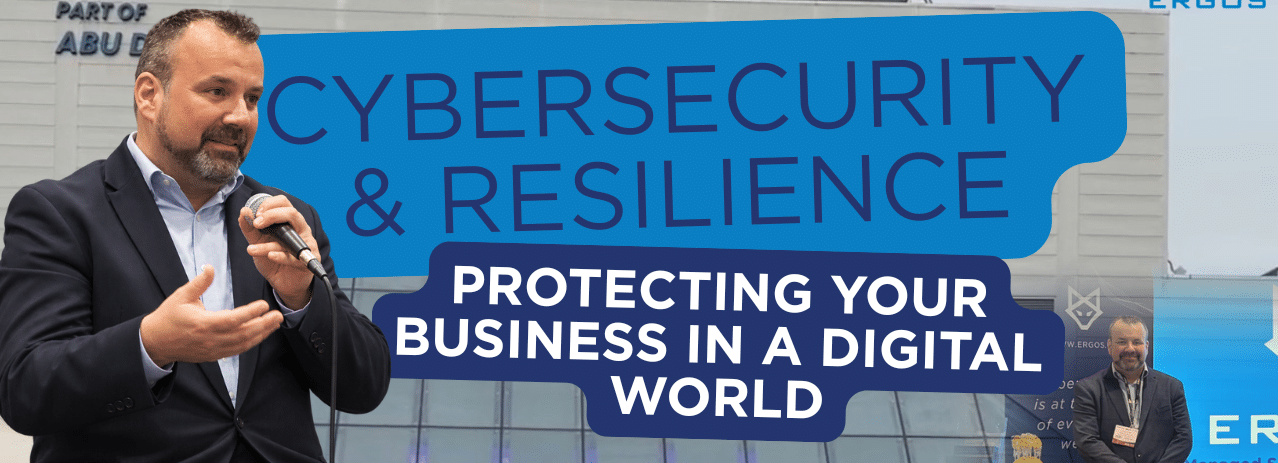
Those were some of the questions discussed at The Business Show London 2026, where Stuart Black, Managing Director of ERGOS Technologies, joined a panel of cybersecurity experts for Cybersecurity & Resilience: Protecting Your Business in a Digital World. The session took place at ExCeL London on 11 November and focused on the growing cyber risks facing UK businesses and, crucially, what they can practically do about them.
You can watch the full discussion below:
▶ Watch Cybersecurity & Resilience: Protecting Your Business in a Digital World on YouTube
Cybercrime doesn’t just happen to big businesses
One misconception that came through strongly in the discussion is the idea that a small or medium-sized organisation somehow isn’t interesting enough to attack, yet unfortunately, cybercrime doesn’t really work that way.
The official description for The Business Show session noted that 43% of UK SMEs had identified a cybersecurity breach in the previous 12 months and that smaller organisations are increasingly being targeted.This is being made even more important through Automation and AI. An attacker doesn’t necessarily need to select your company individually and spend weeks trying to break into it as technology now allows criminals to look for vulnerable accounts, systems and businesses at enormous scale. So perhaps the question businesses should be asking isn’t:
“Why would a cybercriminal attack us?”
A better question is:
“What would a cybercriminal find if they tried?”
It’s something Stuart Black raised directly during the discussion:
“What can a hacker or an AI or a bit of malware actually find out about me today?”
That’s a surprisingly powerful way to approach cybersecurity. Instead of trying to predict every possible attack, start by understanding what an attacker could see and where the weaknesses are in your current environment.
AI is changing both sides of cybersecurity
It would be almost impossible to have a cybersecurity conversation in 2026 without talking about AI.
AI presents huge opportunities for businesses. It can automate repetitive work, analyse information faster and help employees become more productive.
But criminals have access to the same underlying capabilities.
AI can help make a phishing email more convincing. It can remove the spelling mistakes and strange wording that once made scam emails relatively easy to spot. It can help criminals research targets, create convincing content and operate at greater scale.
At the same time, there’s another AI-related risk businesses shouldn’t ignore: what their own employees are doing with AI.
Do you know where your business data is going?
An employee copying a document, customer email or financial information into a personal AI account might not think of it as a cybersecurity decision, but it potentially is. That’s why AI governance needs to become part of the wider cybersecurity conversation and organisations need to understand which AI platforms employees are using, what company information they are putting into them, which applications have AI capabilities and who has access to company data.
The answer isn’t necessarily banning AI.
Quite the opposite. Businesses should be looking at how to enable employees to use AI productively within an environment that they can properly manage and secure.
The panel discussed this in the context of tools such as Microsoft Copilot and the importance of bringing business AI into a controlled environment rather than having uncontrolled personal accounts being used throughout an organisation.
Good cybersecurity doesn’t always need to be complicated
With so many new threats emerging, it’s easy for cybersecurity conversations to become dominated by whichever new technology happens to be making headlines, but some of the most effective ways to improve cybersecurity are still surprisingly straightforward. One of Stuart Black’s recommendations during the session was to look at Cyber Essentials.
Cyber Essentials is the UK government-backed cybersecurity scheme built around five fundamental technical controls: firewalls, secure configuration, security update management, user access control and malware protection. Cyber Essentials Plus takes this a stage further with an independent technical assessment.
Rather than attempting to eliminate every conceivable cyber risk, the aim is to make sure fundamental protections are in place and Stuart Black used a great analogy during the panel:
“If you want to run away from the tiger, you don’t have to be the fastest person, just be faster than the slowest person.”
The point isn’t that businesses should settle for mediocre cybersecurity, it’s that cybercriminals frequently look for the easiest opportunity. If one business has poorly secured accounts, unpatched software and no multi-factor authentication while another has security controls properly implemented, which one represents the easier target? At ERGOS, we believe strongly in Cyber Essentials and are externally audited on our own compliance every year. We also help customers work towards Cyber Essentials as part of a wider cybersecurity strategy built around people, processes and technology.
What happens when someone does get through?
There’s another side to cybersecurity that businesses sometimes overlook.
Cyber resilience isn’t simply about preventing an attack. It’s about what happens next.
Imagine arriving at work tomorrow morning and discovering you can no longer access your systems.You find your files are encrypted. Microsoft 365 isn’t accessible. Your CRM isn’t available.
Could your employees work?
Could you invoice your customers?
Could customers contact you?
Could you access your backups?
Who would make the decisions?
Who calls the cyber insurer?
Who communicates with customers?
These aren’t questions that are best answered for the first time during a real cyberattack.
Practise being attacked before it happens
One of the most practical points from the panel was the value of running a tabletop cyber incident exercise and rather than actually turning systems off, you create a realistic scenario and work through what everyone would do. It often exposes simple but significant issues. Maybe nobody knows who has the insurance company’s emergency number. Perhaps your incident response document lives on the server you’ve just pretended has been encrypted. Or you discover that everyone assumes somebody else is responsible for contacting customers.
Stuart Black drew a useful comparison with physical security:
“People that have been robbed see the value in security systems. They see the value in having an alarm, having a CCTV camera. Cybersecurity is actually the same.”
The difficulty with cybersecurity is that many businesses don’t fully appreciate their dependency on technology until that technology isn’t available and good cyber resilience means having that conversation before something goes wrong.
You have a backup. But do you know you can recover from it?
Backing up data sounds obvious, but having a backup is very different from knowing your business can recover from it. A sensible cybersecurity strategy needs to think beyond whether data is being copied somewhere through to when was the last successful backup? How long would a full restore take? What systems need to come back first? Has the restore process actually been tested?
Those questions move the conversation from backup to genuine business continuity and disaster recovery and that’s ultimately what resilience means: not promising that nothing bad will ever happen, but making sure the business can respond and recover when it does.
Don’t overlook the security of your IT provider
There was another important point in the discussion for any business that outsources IT services. You need to understand how your managed service provider protects itself. An MSP may have privileged access to multiple customers’ systems, infrastructure and data which makes MSPs potentially attractive targets for cybercriminals. The UK Government has specifically highlighted the potential “one to many” impact of an attack against an MSP because compromising a provider can potentially provide a route to multiple customers, which means businesses have every right to challenge their IT provider.
Stuart Black summed it up very simply:
“You need to walk the walk.”
If an MSP is telling customers to take cybersecurity seriously, it needs to demonstrate exactly the same commitment internally. ERGOS holds Cyber Essentials Plus and ISO 27001 certification, alongside ISO 9001 and ISO 14001. Our approach includes 24/7 monitoring and a dedicated Security Operations Centre focused on detecting and responding to cyber threats and these controls matter because cybersecurity shouldn’t just be something your IT provider sells. It should be something it practises.
Cybersecurity needs to make sense to the people running the business
Possibly our favourite comment from Stuart Black during the entire discussion was this:
“You need to find a partner that you trust, who can actually explain the journey to you in human terms, not jargon and acronyms.”
And that’s really the point. A Managing Director shouldn’t need to understand every detail of a SOC, SIEM or EDR platform to know whether the business is protected and a Finance Director shouldn’t need a cybersecurity qualification before someone can explain why an investment is needed. Your technology partner should be able to explain what your risk is, what needs to change and why it matters to the business. Sometimes that will involve sophisticated cybersecurity technology and other times it can be as straightforward as enabling MFA, removing an old user account, patching a laptop or changing the way a backup is configured. In fact, under the current Cyber Essentials requirements, critical and high-risk security updates generally have to be installed within 14 days. It’s not particularly glamorous, but consistently getting fundamentals such as patching right can remove vulnerabilities that criminals might otherwise exploit.
So, where should your business start?
Not necessarily by buying another cybersecurity product. Start by understanding your current position and look at how your Microsoft 365 environment is configured. Understand who has access to what. Check whether MFA is properly deployed. Look at the applications and devices being used throughout the organisation. Find out whether your backups really can be restored. Consider Cyber Essentials and if you want a clearer understanding of what an attacker could actually discover, consider vulnerability assessment or penetration testing. Most importantly, don’t treat the process as a one-off project as cybersecurity needs to evolve alongside your business.
New employees join. People leave. Applications are added. Businesses adopt AI. Data moves. Suppliers change. Criminals find new techniques. The technology changes constantly, but the objective stays remarkably consistent:
Make it difficult to get in, know quickly when something is wrong, and be ready to recover if an attack succeeds.
Watch the full Cybersecurity & Resilience discussion
There was far more covered at The Business Show than we could fit into one article.
The full conversation explores AI-powered attacks, Cyber Essentials, Microsoft 365 security, cyber insurance, password managers, passkeys, penetration testing, public Wi-Fi, backups, deepfakes, patching, choosing an MSP and how businesses can prepare for a cyber incident.
▶ Watch Cybersecurity & Resilience: Protecting Your Business in a Digital World
Talk to ERGOS about your cybersecurity
At ERGOS, we provide managed IT support, cybersecurity and cloud services for UK businesses, with cybersecurity built into the way we deliver IT rather than treated as an optional extra.
Our approach combines people, processes and technology, including 24/7 monitoring, our Security Operations Centre, Cyber Essentials support and wider cybersecurity services designed around the needs and risks of your business.
If you’re unsure where your cybersecurity gaps are, that’s a good place to start the conversation.